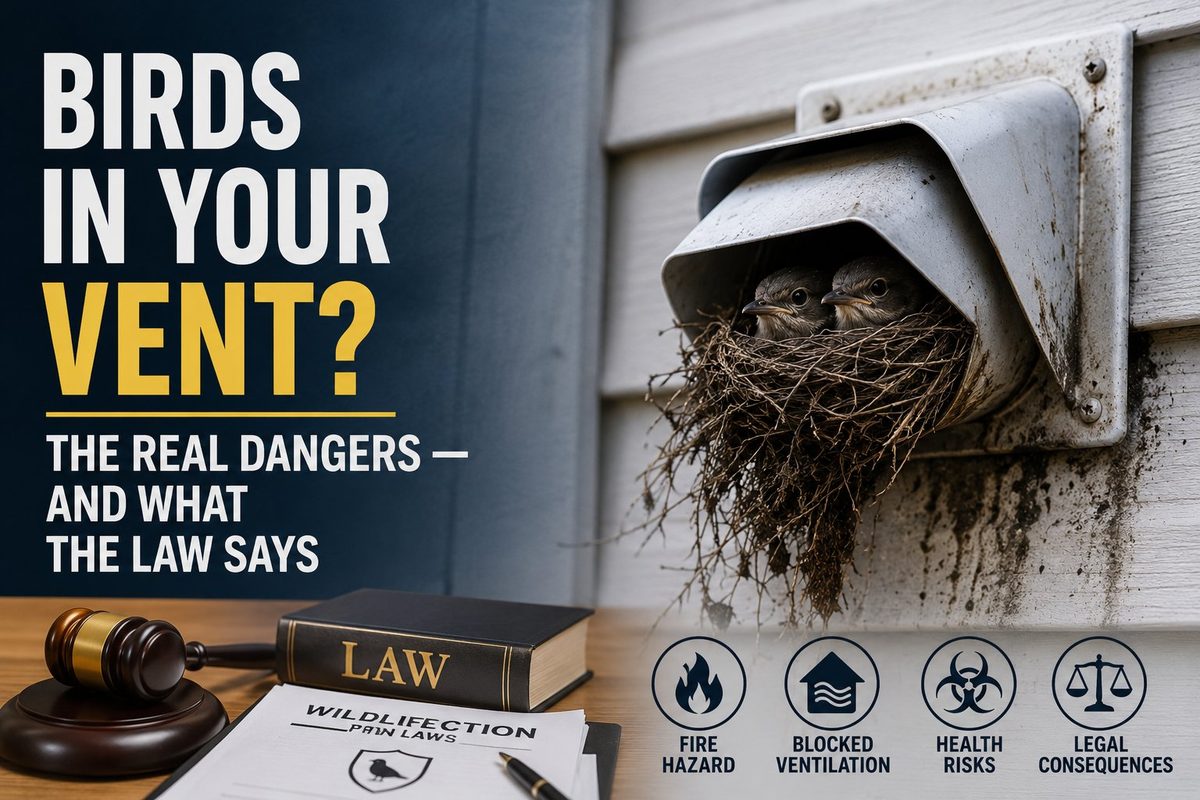
Finding a bird tucked into your dryer or exhaust vent can feel almost charming — until you understand what it can do to your home and discover you may not be allowed to simply remove it. Here's the honest picture for Alberta homeowners — and when removal is allowed, our dryer vent cleaning service handles nest clearing routinely.
A vent nest creates a few risks that are worth taking seriously.
This is the big one. A dryer pushes out hot air and flammable lint. When a nest of dry grass and twigs blocks that path, you've put kindling and a heat source together with nowhere for the heat to escape. Blocked dryer vents are a well-documented cause of house fires, and a packed nest is about as complete a blockage as you can get.
If the blocked vent serves a gas appliance — or sits near one — a blockage can interfere with how combustion gases vent out of your home. That raises the possibility of dangerous gases like carbon monoxide backing up indoors. It's less common than the fire risk, but far more serious when it happens.
A vent that can't breathe traps humid air in the duct and wall cavity, which can lead to mould and musty odours. Add bird droppings and nesting debris, and the air being pulled around that vent isn't something you want circulating through your home.
Once a nest is established, dealing with it is rarely a five-minute job — and as you'll see below, the timing isn't always your choice. What could have been a simple guard becomes a wait-and-then-remediate situation.
Bottom line on danger: the fire risk alone is reason enough to keep birds out of a vent. The carbon monoxide possibility, where a gas appliance is involved, raises the stakes further.
Here's what catches homeowners off guard. In Canada, most wild birds are protected under federal law, including the Migratory Birds Convention Act. In plain terms, that means once a nest is active — that is, it contains eggs or young birds — it's generally against the rules to disturb, move or destroy it until the birds have left on their own.
So if you discover a nest in your vent in the middle of nesting season, after eggs have been laid, your hands may be tied. The usual advice in that situation is to wait until the young have naturally fledged and the nest is empty before clearing it out — which can mean weeks of a blocked, hazardous vent.
The rules can vary by species and situation, and this isn't legal advice — if you're facing an active nest and aren't sure what you're allowed to do, it's worth checking with a wildlife professional or your local authorities. But the practical lesson is clear.
Put the two halves together. A nest is genuinely dangerous, and once it's active you often can't legally remove it right away. That leaves really only one good strategy: stop birds from getting in before they ever start building.
The ideal time to protect a vent is before nesting season begins in spring — while the vent is empty and you're free to act. A guard installed ahead of time sidesteps both the safety hazard and the legal headache entirely.
Layer Latch is a dual-layer vent guard that keeps birds and pests out while letting your vent flap open and exhaust escape normally. Installed before nesting season, it removes the temptation entirely — no nest, no fire hazard, and no waiting on the law to clear a blocked vent. It's one of several ways to protect a vent, and an easy one to put in place ahead of spring.
The best time to protect your vents is before the birds arrive. We'd be glad to take a look and talk through your options — honest advice, flat-rate pricing.