Not all mice are created equal. In Alberta, the two you are most likely to find in a home or acreage are the common house mouse and the deer mouse — and while they look similar at a glance, the difference matters more than most people realize. One is a nuisance. The other is the main carrier of hantavirus, a rare but serious illness spread by breathing in dust from dried mouse droppings and urine. When either one gets into your ductwork, your furnace and air conditioner can quietly spread that dust through the whole house. Here is how to tell them apart, why it matters, and exactly what to do about it.
Two Very Different Mice, One Alberta Home
The house mouse (Mus musculus) is the classic city and suburb mouse — the one that moves into walls, kitchens and garages, especially as the weather cools. The deer mouse (Peromyscus maniculatus) is more of a rural and acreage mouse, common around Alberta’s fields, sheds, cabins, garages and outbuildings, though it readily moves into houses too. Both are small, brownish and quick, which is why they get lumped together. But their differences are easy to spot once you know what to look for — and those differences change how carefully you should handle any mess they leave behind.
How to Tell a Deer Mouse from a House Mouse
You do not need to be an expert. Two features give it away almost every time — the belly and the tail:
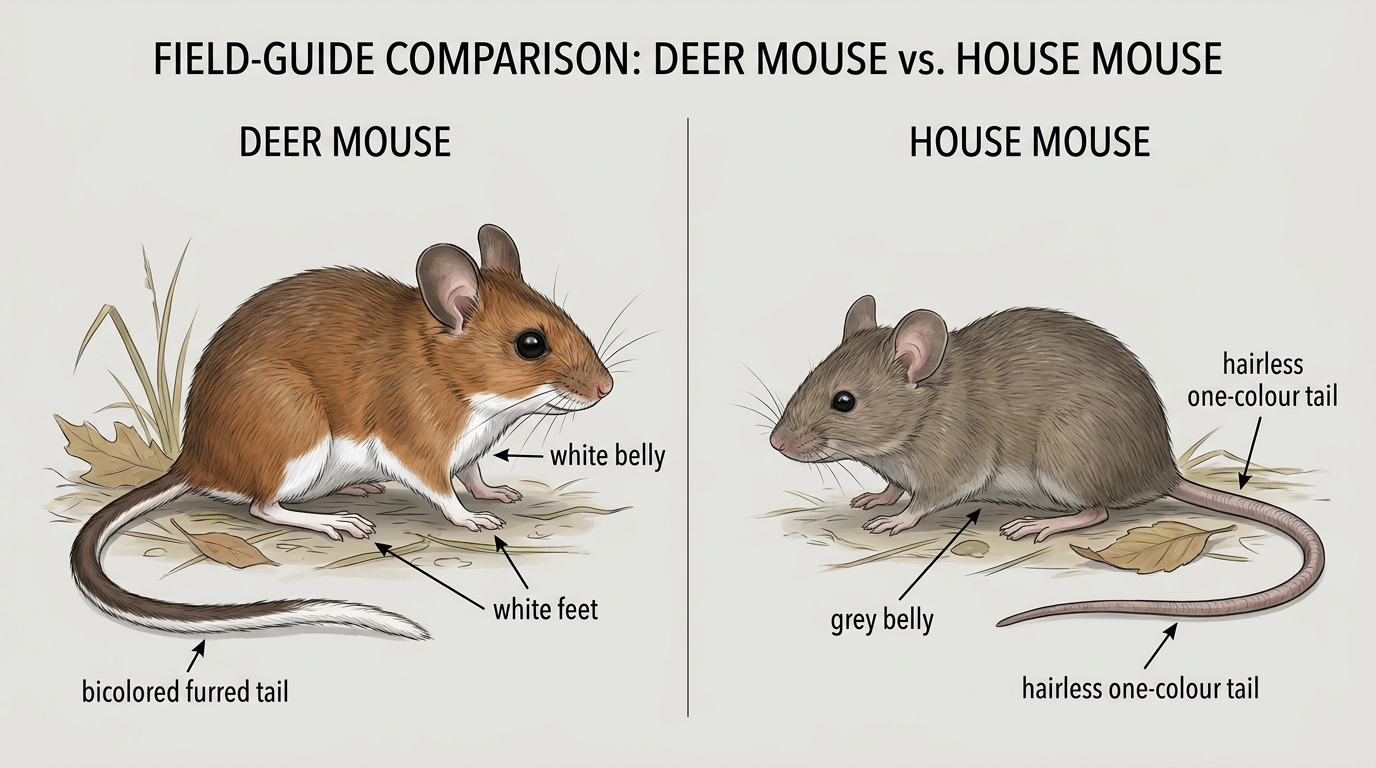
- The belly. A deer mouse has a crisp, pure white belly and white feet that contrast sharply with its brown back. A house mouse is a fairly uniform grey-brown all over, with a grey belly that is only slightly lighter than its back.
- The tail. This is the clearest tell. A deer mouse’s tail is sharply two-toned — dark on top, white underneath — and carries a light coat of fur. A house mouse’s tail is a single dull colour, scaly and nearly hairless.
- Ears and eyes. Deer mice have noticeably larger ears and bigger, darker eyes for their size, giving them a wide-eyed look. House mice have smaller, more proportionate features.
- Where you find them. Deer mice turn up more often in garages, sheds, cabins, crawl spaces and acreage outbuildings; house mice favour the heated, food-rich core of a home. Location is a clue, not proof — check the belly and tail to be sure.
Why It Matters: Deer Mice and Hantavirus
Here is the reason this is worth learning. Deer mice are the primary carrier of hantavirus in North America — specifically the Sin Nombre virus, which can cause Hantavirus Cardiopulmonary Syndrome (HCPS), a rare but potentially life-threatening lung illness. People become infected by breathing in tiny airborne particles from the dried urine, droppings or nest material of infected deer mice, which get stirred into the air when the material is disturbed.
It is rare — the Public Health Agency of Canada has confirmed 168 cases across the country since surveillance began in 1994 — but it is serious, there is no vaccine, and the Prairies see their share of cases. Common house mice are not a hantavirus reservoir in the same way, which is exactly why identifying a deer mouse changes how you should respond. If the belly is white and the tail is bicoloured, treat the cleanup with extra caution.
The HVAC Danger: Mice in Your Ductwork
This is where our world and this health issue overlap. Ductwork is warm, dark, hidden and full of soft insulation — in other words, prime real estate for a mouse looking to nest. Once mice move into ducts, a furnace cabinet or the blower compartment, they leave droppings, urine and nesting debris behind.
The problem is what happens next. As that material dries, it can break down into a fine dust. Every time your furnace or air conditioner fan switches on, air rushes through those ducts — and can carry that dust out through the vents into the rooms where your family sleeps and breathes. A mouse nest in the ducts is not just a smell or a noise complaint; it is a potential way to distribute contaminated dust through the entire home. That is why a rodent problem inside an HVAC system deserves more than a quick wipe-down of the vent covers.
The one rule to remember: never sweep or vacuum dry droppings. Alberta Health Services is explicit about this — sweeping or vacuuming throws virus-carrying dust into the air, which is exactly how people get exposed. Always wet the material down with disinfectant first, and air out the space before you start.
How to Clean Up Safely — The Alberta Health Services Way
For a small, accessible mess, Alberta Health Services lays out a clear routine:
- Air it out first. Open windows and doors to ventilate, then leave the area for at least 30 minutes before you go back in to clean.
- Glove up and wet it down. Wear rubber gloves and thoroughly soak the droppings, nests or dead mice with a household disinfectant, or a bleach solution of one part bleach to nine parts water. Let it sit about five minutes.
- Wipe, don’t sweep. Pick everything up with damp paper towel, bag it, and wash your hands well afterward. Never dry-sweep or vacuum.
- Know when to call for help. For a large infestation, an enclosed or poorly ventilated space, or contamination inside ductwork you cannot safely reach, get help rather than disturbing it yourself. Alberta’s Health Link line (811) can advise on precautions.
How Home Pros Group Helps: Duct Cleaning + Disinfection
When mice have been in the HVAC system, the contamination is often somewhere you cannot reach or safely clean on your own — deep inside the ducts, the furnace or the blower. That is where we come in, and we handle it in two steps:
- Professional duct cleaning. We physically remove the nests, droppings, insulation debris and built-up dust from inside the duct system, using powerful equipment that reaches the full run of ductwork — not just the few inches behind the vent cover.
- Botanical disinfection with Benefect. Cleaning removes the mess; disinfection treats the surfaces it touched. Benefect is a Health Canada registered botanical disinfectant made from thyme oil (its active ingredient is thymol), and we can apply it to the duct system and affected areas after cleaning to disinfect the surfaces the mice contaminated.
- Then keep them out. Cleaning and disinfecting solves the contamination; sealing entry points keeps it from coming back. For an active infestation, pair the HVAC work with a pest professional who can trap the mice and seal the gaps they used to get in.
The goal is simple: get the contamination out of the air path your family breathes, disinfect what is left, and stop the next mouse from moving in.
And if they were in the attic, the insulation is the other half of the problem. Nesting and droppings work down through loose-fill and stay there, so the material holds both the contamination and the smell no matter what is blown on top of it. That is insulation removal — vacuumed out under sealed containment rather than swept, precisely because disturbed dust is the exposure route described above. Once the attic is clean, new insulation goes back in the same visit.
Deer Mouse vs. House Mouse: Quick Answers
How can I tell a deer mouse from a house mouse?
The quickest tell is the tail and the belly. A deer mouse has a sharply two-toned tail, dark on top and white underneath, with a light coat of fur on it, plus a pure white belly, white feet, and noticeably large ears and eyes. A house mouse is a fairly uniform grey-brown all over, including its belly, with smaller ears and a scaly, nearly hairless tail that is a single colour. If the belly is white and the tail is bicoloured, you are almost certainly looking at a deer mouse.
Why are deer mice more dangerous than house mice?
Deer mice are the main carrier of hantavirus in North America, the virus that causes Hantavirus Cardiopulmonary Syndrome, a rare but serious lung illness. People catch it by breathing in dust from the dried urine, droppings, or nesting material of infected deer mice. Common house mice are not a hantavirus reservoir in the same way, so correctly identifying a deer mouse tells you to take extra care with cleanup.
Can mice living in my ductwork make me sick?
They can raise the risk. If deer mice nest inside ducts, a furnace, or the blower, their droppings and urine dry out and can break down into a fine dust. Every time the furnace or air conditioner fan runs, that dust can be pushed through the ducts and out into the rooms where your family breathes. That is why a rodent problem inside an HVAC system is worth taking seriously, not just wiping up the visible mess.
How do I safely clean up mouse droppings?
Follow Alberta Health Services guidance: open windows and doors to air out the space and stay out of it for at least 30 minutes first. Then wear rubber gloves and thoroughly soak the droppings, nests, or dead mice with a disinfectant or a bleach solution of one part bleach to nine parts water, let it sit about five minutes, and wipe up with damp paper towel. Never sweep or vacuum dry droppings, because that throws virus-carrying dust into the air.
Does duct cleaning remove mouse contamination?
Professional duct cleaning physically removes the nests, droppings, and debris that mice leave inside the duct system, along with the dust those droppings break down into. On its own it does not disinfect, which is why it is paired with a disinfectant treatment. Together, cleaning plus disinfection is a far more thorough response than trying to reach into the ductwork yourself.
What is Benefect and does it help?
Benefect is a Health Canada registered botanical disinfectant made from thyme oil, with thymol as its active ingredient, used to disinfect surfaces after cleaning. Home Pros Group can apply it to the duct system and affected areas after a cleaning to disinfect the surfaces the mice contaminated. Always follow the product label, and for a heavy or hidden infestation, bring in a pest professional to remove the mice and seal their entry points too.
Trusted Sources
The health and cleanup guidance above is drawn from Alberta and Canadian public-health authorities.
Alberta Health Services
Simple precautions can reduce the risk of hantavirus — the ventilate, wet-down and never-sweep cleanup routine.
Read the adviceAlberta.ca Hantavirus
The province’s guide to reducing hantavirus risk, including safe cleanup steps for homes and outbuildings.
See the guideMyHealth Alberta
Hantavirus Cardiopulmonary Syndrome — how the illness spreads, its symptoms, and who is most at risk.
Learn moreGovernment of Canada
Public Health Agency of Canada — hantavirus symptoms, spread, prevention and national case data.
View the factsLinks open official government and health-authority sites in a new tab. Home Pros Group isn’t affiliated with these organizations.
Think Mice Have Been In Your Ducts?
Home Pros Group has cleaned furnaces, ducts and dryer vents across Spruce Grove, Stony Plain and the Greater Edmonton Area since 2002. If you have found droppings near your vents or furnace, we can clean the system out and disinfect it with Benefect — so what the mice left behind isn’t circulating through your home.
This article is general information about rodent identification and indoor air quality, not medical advice. Hantavirus and cleanup guidance is summarized from Alberta Health Services, Alberta.ca and the Public Health Agency of Canada; always follow current public-health direction and product labels. If you may have been exposed to deer mouse droppings and feel unwell, contact Health Link at 811 or your doctor.