“What causes this? Is there a fix I can do to get it up and running? My house is miserable tonight. :(”
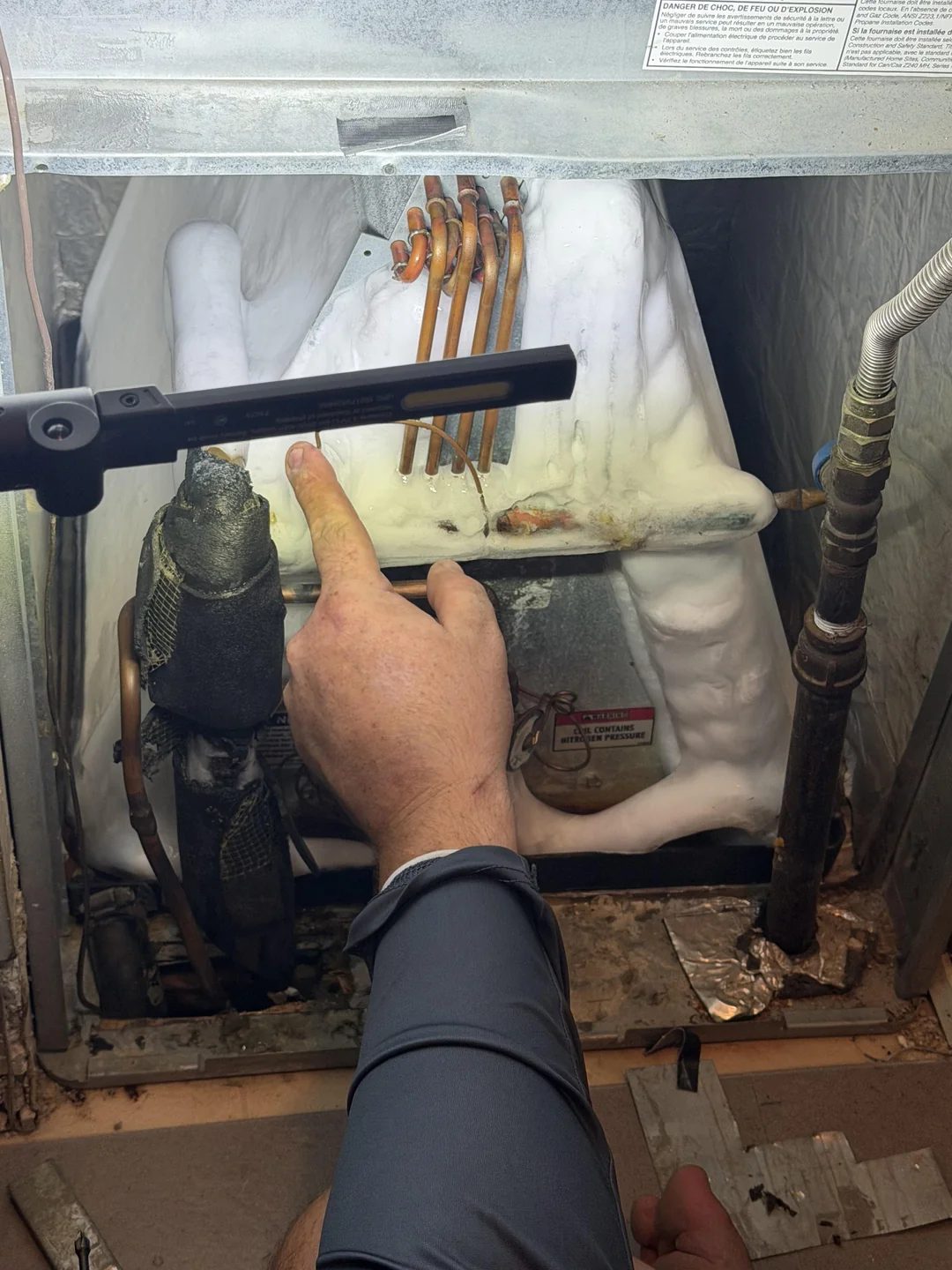
Yes, there’s something you can do tonight — and something you should stop doing right now.
Stop First: Shut The Cooling Off
Turn the cooling off before you do anything else
Running the compressor with the coil iced like that sends liquid refrigerant back down the suction line to the compressor — and that’s how a filter problem turns into a compressor replacement.
Now Thaw It
Set the thermostat to OFF for cooling and set the FAN to ON. That runs the blower without the compressor and melts the ice with house air. A block that solid is a 3–6 hour job, possibly overnight.
- Thermostat: cooling OFF, fan ON. The blower does the thawing. Nothing else needs to be running.
- Do not chip, scrape, or pick at it. That’s soft copper and thin aluminium fin under there, and a puncture means the whole coil gets replaced.
- Put towels down before you start. All that ice is about to become several gallons of water, and in this photo it’s sitting well past the edges of the drain pan.
- Expect a float switch trip. If you’ve got a condensate float switch, it may trip partway through.
- While it thaws, pull your filter. If it’s grey, or you can’t see light through it, that’s very likely your answer.
- Walk the house. Open every supply register, and make sure nothing is stacked against a return grille.
What Actually Causes It
The coil drops below 32°F and the condensation freezes instead of draining. Two things do that:
- Not enough air across the coil — a dirty filter, a dirty blower wheel, a dirty coil, closed registers, or blower speed set wrong.
- Not enough refrigerant — which means a leak.
Once ice starts, it blocks airflow further, which makes more ice. That feedback loop is why it goes from “seems fine” to a solid block in a day.
What This Particular Photo Suggests
Airflow
A low-charge freeze usually starts at the metering device end and creeps unevenly. This one is a uniform slab across the whole face, which is more typical of a coil that just isn’t getting enough air. Not conclusive — but it’s where we’d look first.
How To Tell For Sure
Once it’s fully thawed, put in a clean filter and run it.
- Another few days with no ice — it was airflow, and you fixed it.
- Ice again within 24–48 hours — you have a refrigerant leak and you need a licensed technician. Topping it off without finding the leak just buys you a few months.
Two More Things In That Photo
- The suction line insulation is completely shot — torn open with the mesh showing. That’s not what froze the coil, but it’s cheap to fix and it’s costing efficiency.
- The nitrogen shipping tag is still hanging on the coil, which suggests a fairly recent install. If it is — and it’s already freezing — we’d have some pointed questions for whoever put it in.
For tonight
Fan on ON moves air, but it won’t cool anything. Box fans until it thaws.
Coil Iced Up More Than Once?
If the filter was clean and it froze anyway, the coil itself is usually the restriction. We clean the coil area, the blower and every run in one visit — flat rate, honest answers, no pressure.